The Tourist Visa Problem (That Most People Solve the Wrong Way)
You come to Thailand for a vacation. You get a tourist visa for 60 days. Maybe you extend it for another 30 days.
Total: a maximum of 90 days in the country.
Then you have to leave. No exceptions.
If you have invested money in property in Phuket, want to rent it out to tourists and want to live there throughout the year, this setup does not work.
You need a long-term visa.
And this is where the confusion starts.
In Phuket, there are four main options suitable for property owners:
1️⃣ DTV visa (Destination Thailand Visa) — new, accessible and designed for digital nomads
2️⃣ LTR visa (Long-Term Resident) — for investors with investments from $500,000 and total assets from $1 million
3️⃣ Thailand Elite visa — a premium option for simply living in Thailand without unnecessary questions
4️⃣ Retirement visa — for people aged 50+ (added based on the business comment)
And here is the main point: if you have bought property in Phuket, getting any of these visas becomes easier.
Because property gives you a basis, income and status.
Let’s look at how it works.
Part 1: Why a Tourist Visa Is a Trap
The Real Limitations of a Tourist Visa
Many people think: "I’ll come, get a tourist visa and just return every 90 days."
It sounds simple. In practice, it is painful.
Here is what you face:
❌ A maximum of 90 days per year (in practice)
- 60 days on a tourist visa
- +30 days of extension (only once per calendar year)
- After that, you must leave the country
- No exceptions
❌ Leaving costs money and time
- Ticket to Laos/Cambodia: from 3,000 baht ($90 / 7,282 RUB)
- Time: 2-3 days on the road there and back
- Stress: every exit creates a risk that you may not be allowed back in (even if that risk is low)
❌ Immigration starts asking questions
After 90 days, it becomes clear that you are constantly entering and leaving. Immigration starts looking at you with suspicion.
- "Are you working in Thailand without permission?"
- "Where does the money for hotels come from?"
- "What are you really doing here?"
A tourist visa is not designed for permanent residence.
❌ Renting your apartment to tourists falls into a gray area
If you are the owner, technically you should pay tax on the income.
But on a tourist visa, this becomes a conflict: you are not a resident, you do not have proper status and you cannot officially register.
Conclusion: A tourist visa is a temporary solution, not a strategy for an investor.
Part 2: Four Long-Term Visa Options in Phuket
The New Mainstream Option: DTV Visa (Digital Nomad Visa)
DTV is the newest visa. It appeared in July 2024. And it changes the game.
What it is:
A visa for digital nomads, remote workers and freelancers. It is also suitable for people coming for educational programs such as Muay Thai, cooking courses or medical treatment.
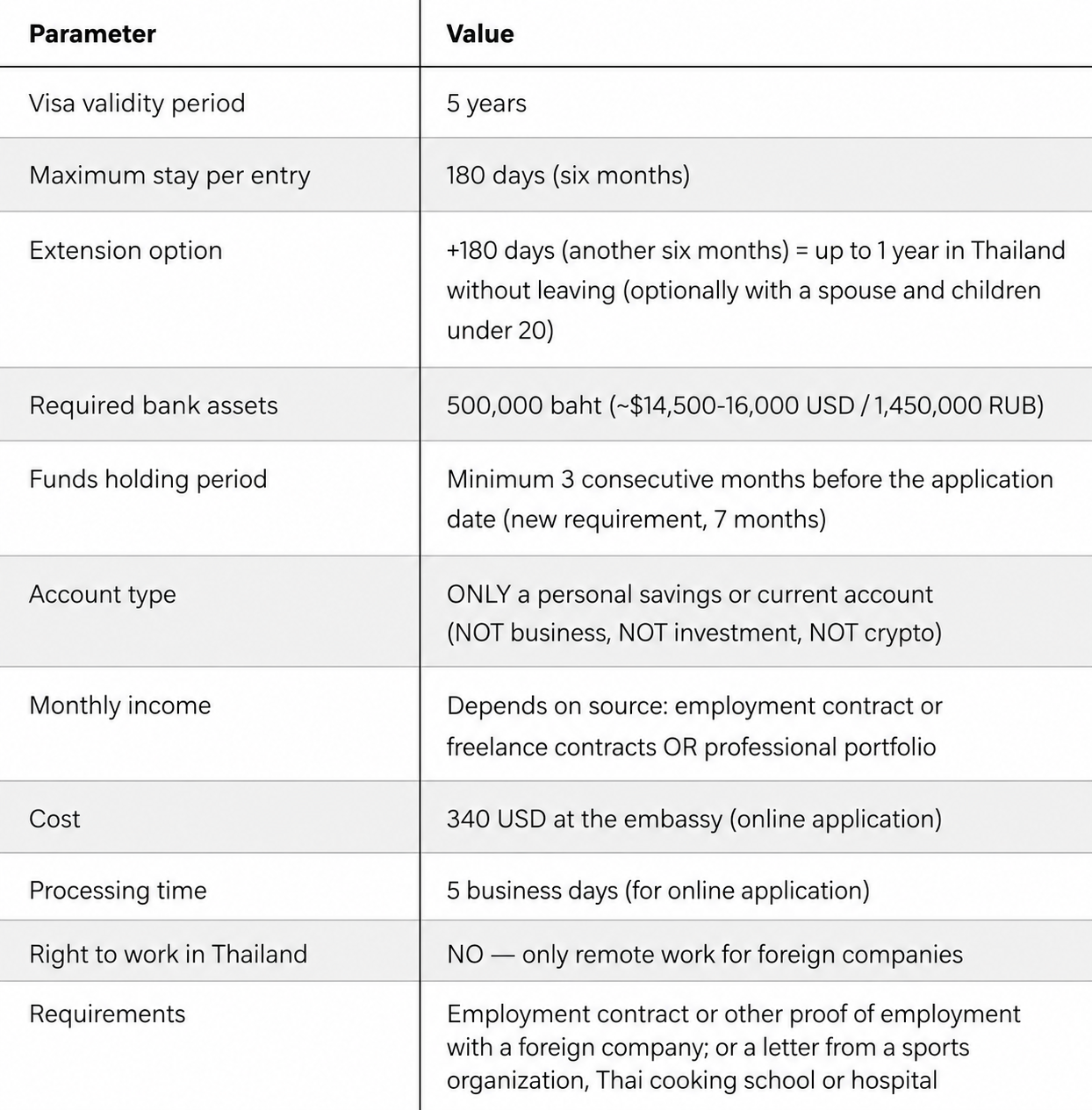
Key parameters (CURRENT FOR 2026):
Who it fits:
- Freelancers who work for foreign clients
- Remote employees of foreign companies
- Owners of online businesses with income from abroad
- Anyone with passive income from outside Thailand
Required documents:
✅ Passport (valid for 6+ months)
✅ Photo (taken within the last 6 months)
✅ Bank statements (confirming 500,000 baht for the last 3 months)
✅ Employment contract OR client contracts (for freelancers)
✅ Professional portfolio (for freelancers without a contract)
✅ Health insurance (minimum coverage of 500,000 baht)
The main benefit for you as a property owner:
If you rent your apartment to tourists and receive income in foreign currency, it is considered "passive income from abroad." The DTV visa allows you to officially stay in the country and receive that income.
⚠️ IMPORTANT: You cannot work in Thailand on a DTV visa. All income can only be earned from abroad. The only advantage of this visa is long-term stay: up to 1 year without leaving.
You become a resident, not a tourist.
The Classic Choice: LTR Visa (Long-Term Resident)
LTR is a powerful visa for investors. It appeared in September 2022 and was created specifically for people with income and assets.
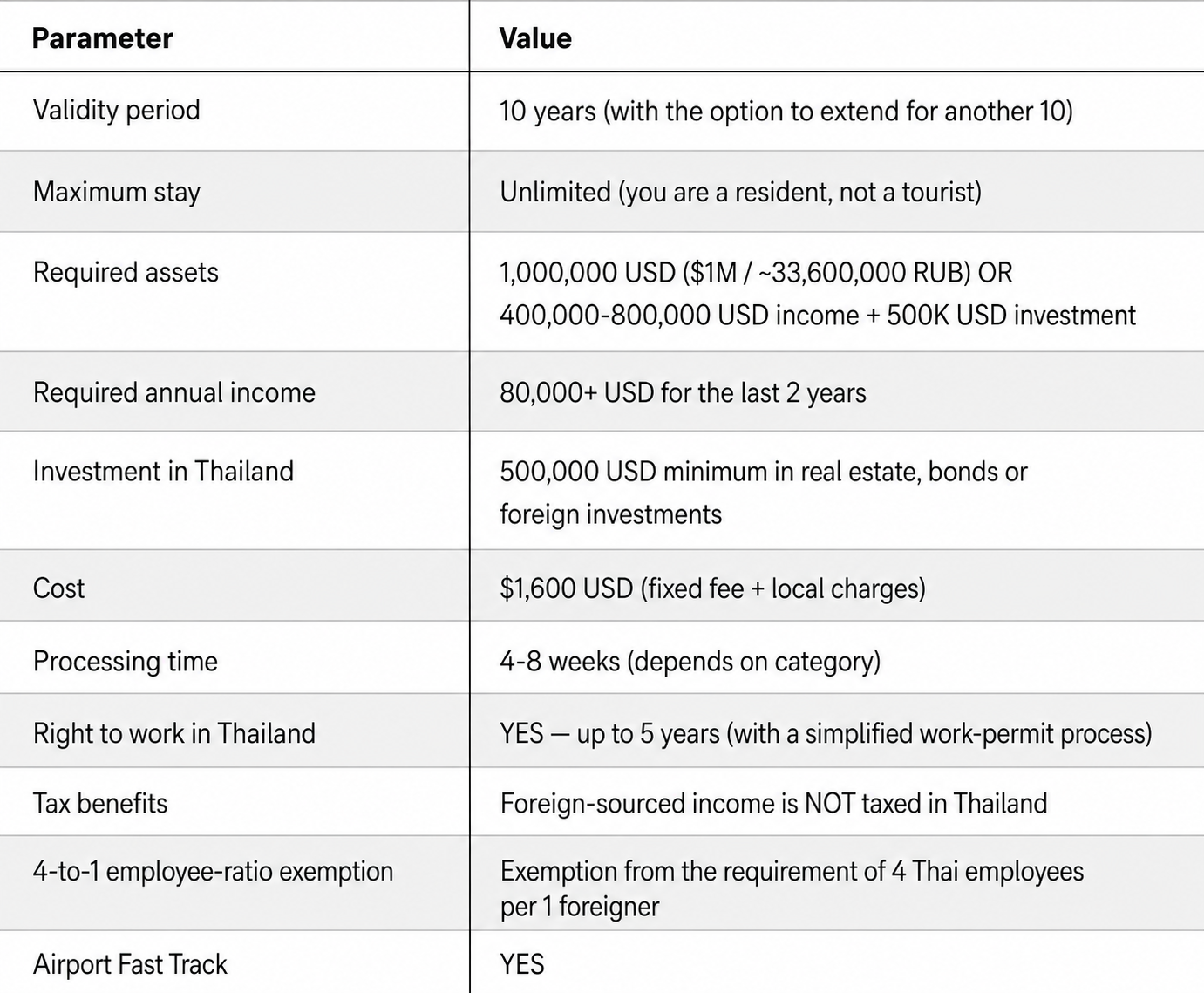
Key parameters (CURRENT FOR 2026):
4 LTR categories:
🟢 Category 1: Wealthy Global Citizen
- Required assets: minimum 1,000,000 USD
- Investment: 500,000 USD in Thailand (real estate, bonds or FDI)
- Required annual income: minimum 80,000 USD for the last 2 years
🟢 Category 2: Wealthy Pensioner (50+)
- Requirement: at least 50 years old
- Pension/income: 80,000 USD/year OR 40,000-80,000 USD + 250,000 USD investment in Thailand
- Alternative: 100,000 USD in a bank account (minimum 12 months) + 50,000 USD insurance
🟢 Category 3: Work-From-Thailand Professional
- Required income: 80,000 USD/year for the last 2 years OR 40,000-80,000 USD with a degree/IP/Series A funding
- Employer: listed on a stock exchange OR operating for 3+ years with minimum 50M USD revenue (updated in 2025)
- Work experience: 5+ years within the last 10 years
🟢 Category 4: Highly-Skilled Professional
- Required income: 80,000+ USD/year for the last 2 years OR 40,000-80,000 USD with a degree/IP/Series A funding
- Target industries: IT, engineering, medicine, science and research
- Work experience: 5+ years within the last 10 years
The main benefit for you as a property owner:
If you bought property for 3,500,000 baht ($105,000 USD / ~3,528,000 RUB) and rent it out to tourists:
- The property counts as an asset (included in the 1,000,000 USD)
- Tourist rental income counts as qualifying income (passive income from abroad)
- Tax benefits: foreign-sourced income through Airbnb, Booking, etc. is NOT taxed in Thailand
- Significant savings: if income is 500,000 baht/year, tax savings can exceed 125,000 baht
LTR also has another advantage: Fast Track at the airport, with no queues. This makes passport control faster when entering and leaving Thailand.
This is a powerful combination.
The Premium Choice: Elite Visa (Thailand Privilege)
Elite is not for investment. It is for enjoying life with VIP service.
Key parameters (CURRENT FOR JANUARY 2026):
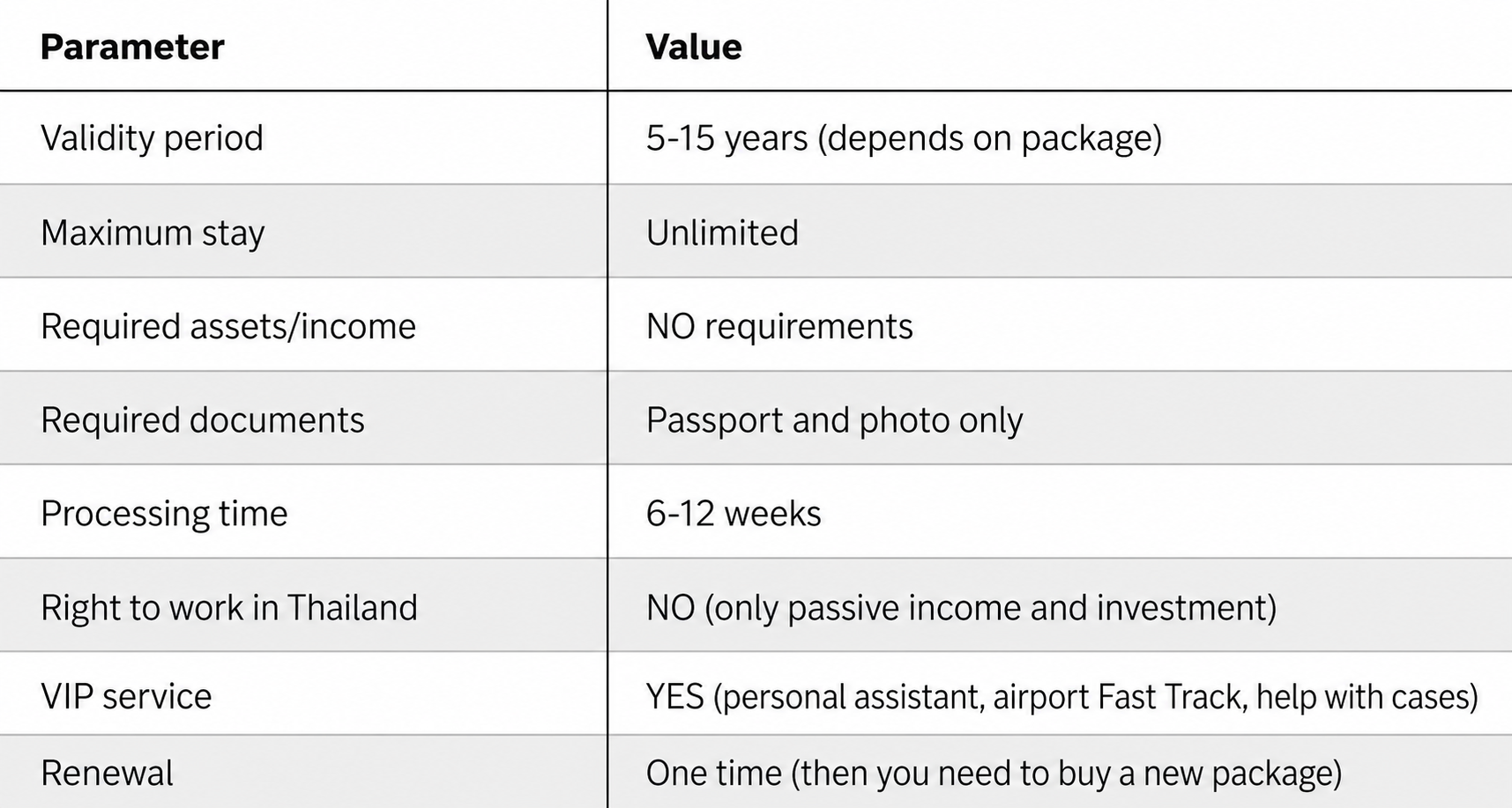
Elite packages (UPDATED FOR 2026):
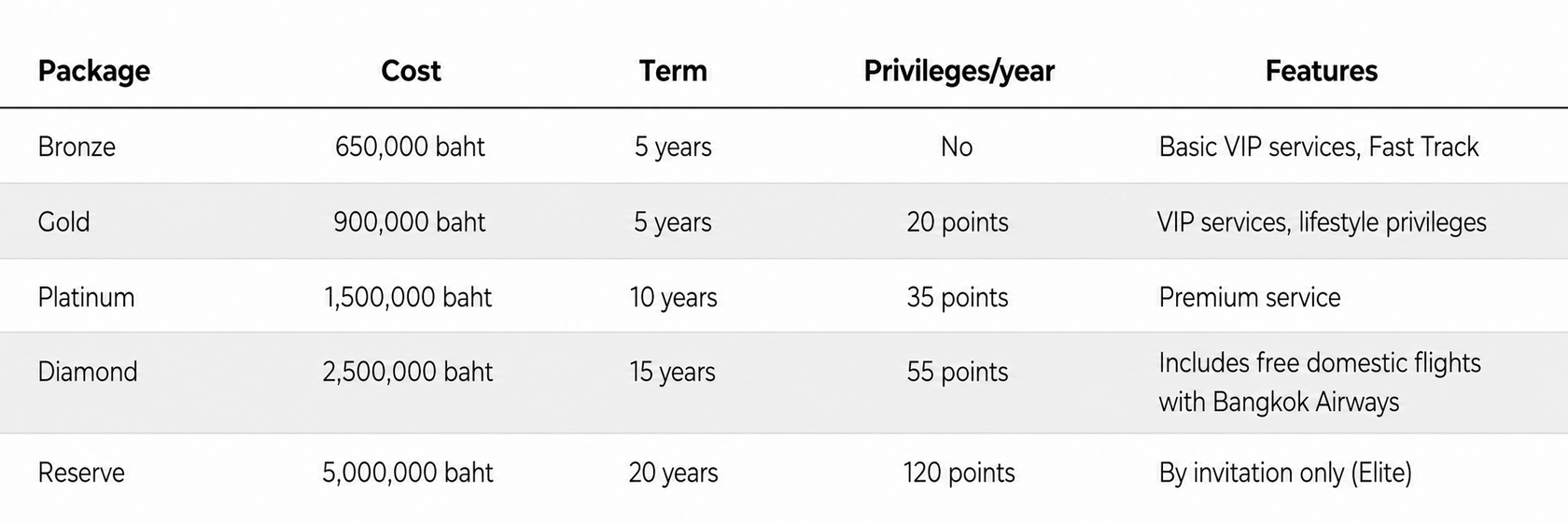
The main benefit for you as a property owner:
If you simply want to live in Phuket without thinking about documents and requirements, choose Elite.
- No income certificates
- No asset requirements
- No questions about the purpose of your stay
- You pay, receive the visa and live comfortably
It is ideal if you have the funds and do not want to deal with bureaucracy.
Retirement Visa for People Aged 50+
It is different from the others: it is inexpensive to obtain and is issued for one year with the possibility of renewal.
The Retirement visa (Non-Immigrant O-A and O-X) is an ideal option for people over 50. This visa is often overlooked, but it is one of the most accessible and practical options.
Key parameters (CURRENT FOR 2026):
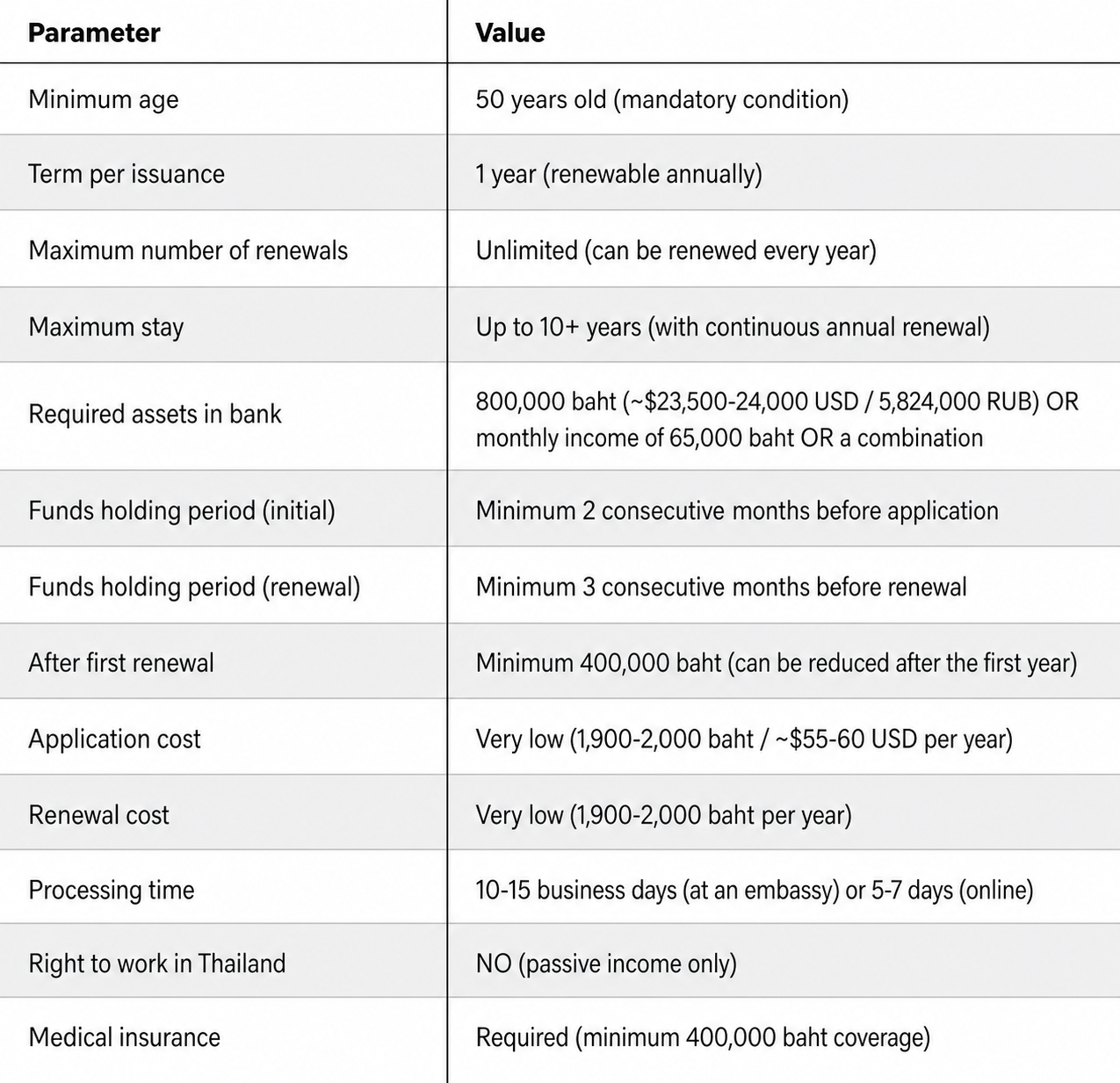
Three financial requirement options:
🟢 Option 1: Bank deposit
- 800,000 baht (~$24,000 USD) in a Thai bank
- Held for 2 months before first issuance
- Held for 3 months before each renewal
- After the first renewal, it can be reduced to 400,000 baht
🟢 Option 2: Monthly income
- Pension or regular income of 65,000 baht (~$1,900 USD) per month
- Source: from abroad (the main condition)
- Confirmation from a bank or embassy is required
🟢 Option 3: Combination (the most flexible)
- Bank balance + annual income = 800,000 baht
- Example: 400,000 baht in the bank + 400,000 baht in annual income
- The most practical option for most people
Who it fits:
- People over 50 with a pension
- People with regular income from abroad (funds, investments, pension)
- People who want to minimize visa expenses
- People who want to live in Thailand permanently and long term
Required documents:
✅ Passport (valid for 6+ months)
✅ Photo (taken within the last 6 months)
✅ Bank statements or certificate (confirming 800K baht or a combination)
✅ Income certificate (if choosing the income option)
✅ Health insurance (minimum coverage of 400K baht)
✅ Police clearance certificate (no older than 3 months)
✅ Health certificate (certain illnesses are incompatible with the visa)
The main benefit for you as a property owner aged 50+:
If you are 50+ and own property in Phuket:
- The cheapest visa (1,900-2,000 baht per year)
- The most practical option for long-term residence
- The bank amount (800K baht) can later be reduced to 400K baht
- It can be renewed an unlimited number of times
- It is ideal for retirees and people with passive income
⚠️ IMPORTANT: The first time, you need to prepare 800,000 baht, but after the first renewal this amount may be reduced to 400,000 baht.
It is one of the most economical and stable visas for long-term residence.
Part 3: Property + Visa = the Ideal Combination
Scenario 1: You Are a Remote Worker (DTV Visa)
You are a freelancer or remote employee. You earn $2,000-3,000 per month remotely.
Step 1: Buy property in Phuket
- Price: 3,500,000 baht
- Down payment: 1,050,000 baht (30%)
- Installment plan: 2,450,000 baht over 2-3 years
Step 2: Get a DTV visa
- Required assets: 500,000 baht in the bank (you have this from the down payment)
- Income: work documents (you have client contracts)
- Processing time: 5 business days
Step 3: Rent the apartment to tourists as additional income
- Income: 500,000-700,000 baht per year (passive, seasonal)
- Taxes in Thailand: 0% (foreign-sourced income through payment systems)
- Installment payments are covered by tourist rental income
Result after 3 years:
- The DTV visa is valid (5 years still remaining)
- The apartment is fully paid off
- The apartment generates 150,000+ baht per year in income
- You are officially a resident of Thailand with legal status
Scenario 2: You Are an Investor With Income (LTR Visa)
You are a business owner or fund owner. You earn $100,000+ per year.
Step 1: Buy property in Phuket
- Price: 3,500,000 baht ($105,000 USD)
- Down payment: 1,050,000 baht (30%)
- Installment plan: from business profit over 2-3 years
Step 2: Get an LTR visa (Work-From-Thailand or Wealthy Global Citizen category)
- Required assets: 1,000,000 USD (property worth $105K + savings)
- Required income: 80,000+ USD (your business/investments)
- Investment: 500,000 USD (the same property + bonds/deposits)
- Processing time: 4-8 weeks
Step 3: Receive tax benefits + Fast Track
- Foreign-sourced business income: 0% tax in Thailand (LTR benefit)
- Tourist rental income: 0% tax (foreign-sourced income)
- Airport Fast Track: Phuket, Bangkok, Chiang Mai and others (no queues)
- Tax savings: 1,000,000+ baht per year (with income of 5,000,000 baht)
Result after 3 years:
- The LTR visa is valid (10 years still remaining)
- The apartment is fully paid off
- The apartment generates 500,000+ baht per year in income
- Tax benefits apply to all foreign-sourced income
- Airport Fast Track makes travel easier
- Tax savings: 3,000,000+ baht over 3 years!
Scenario 3: You Simply Want to Live in Thailand (Elite Visa)
You are a retiree, consultant or financially comfortable person who wants convenience.
Step 1: Buy property in Phuket
- Price: 3,500,000 baht
- Down payment: 1,050,000 baht (30%)
- Installment plan: without rushing, over 3-5 years
Step 2: Get an Elite visa
- Required assets: none
- Required income: none
- Cost: 900,000-1,500,000 baht (Gold package for 5 years)
- Processing time: 6-12 weeks
Step 3: Live without unnecessary concerns
- Visa for 5-10 years (renewable)
- VIP service (help with errands, personal assistant)
- Fast Track at Phuket and Bangkok airports
- Special services: help with banking, taxes and immigration
Result after 3 years:
- The Elite visa is valid (2-7 years still remaining)
- The apartment is fully paid off
- You live comfortably with VIP service
- The apartment generates 500,000+ baht if you choose to rent it out
- No immigration questions and no complex requirements
Scenario 4: You Are 50+ With a Pension (Retirement Visa)
You are a retiree with regular income of 65,000+ baht per month or 800,000 baht in the bank.
Step 1: Buy property in Phuket
- Price: 3,500,000 baht
- Down payment: 1,050,000 baht (30%)
- Installment plan: from pension income over 2-3 years
Step 2: Get a Retirement visa
- Required assets: 800,000 baht in the bank OR monthly income of 65,000 baht
- Age: 50+ years
- Application cost: very low (1,900-2,000 baht per year = $55-60)
- Processing time: 10-15 days
Step 3: Renew every year (very simple)
- Annual renewal: 1,900-2,000 baht (cheaper than coffee)
- After the first year: the minimum assets can be reduced to 400,000 baht
- Unlimited renewals
- Rent the apartment to tourists and use the income to cover installment payments
Result after 3 years:
- The Retirement visa has been renewed 3 times and is valid for the 4th year
- The apartment is fully paid off
- The apartment generates 500,000+ baht per year in income
- Minimal visa expenses: only about 6,000 baht over 3 years
- You live in a country you love
- Everything is legal and secure
MAIN ADVANTAGE of this scenario: The cheapest visa with the longest stay. Ideal for retirees who want to live in Thailand permanently without unnecessary costs or worries.
Part 4: Comparison of DTV, LTR, Elite and Retirement Visas
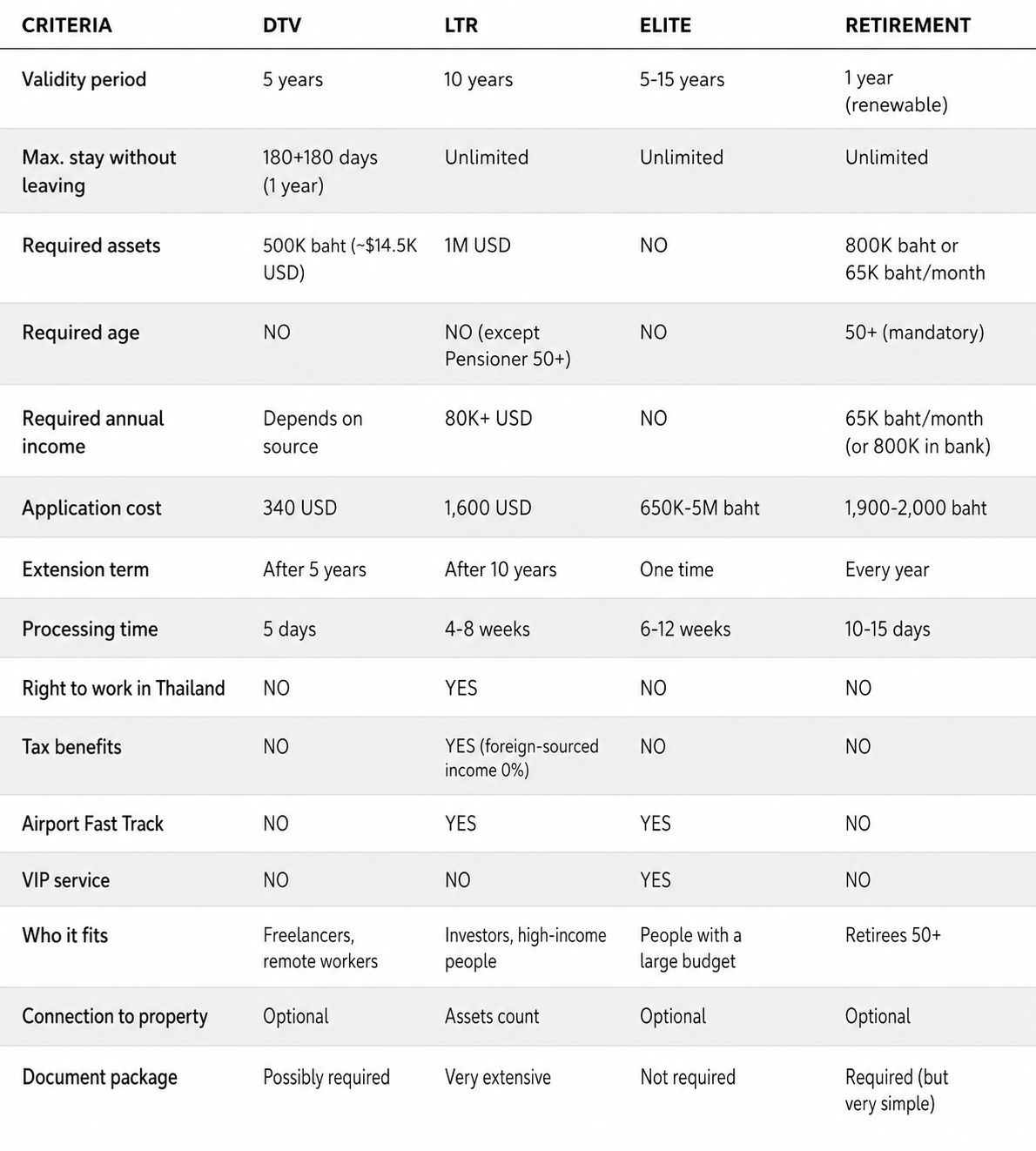
Part 5: Visa Application Process
How to Get DTV
Stage 1: Prepare documents (1-2 weeks)
- Passport with 6+ months of validity
- 3 bank statements for consecutive months confirming 500K baht
- Employment contract OR client contracts
- Professional portfolio for freelancers
- Health insurance with minimum coverage of 500K baht
- Photo taken within the last 6 months
Stage 2: Online application (1 hour)
- Go to https://www.thaievisa.go.th/
- Fill out the form
- Upload all documents (official documents only, NOT screenshots)
- Pay the fee (340 USD) by credit card
Stage 3: Review (5 business days)
- The Immigration Bureau checks the documents
- Approval/rejection is sent with notification
- You receive an electronic visa (e-Visa)
Stage 4: Enter Thailand (1 day)
- The e-Visa is valid for entry
- If needed, you can get a sticker at the embassy
Total time: 3-4 weeks from the start to entering Thailand
Tip: Make sure the 500K baht was in your account for the full 3 months. Even if you withdraw the money later, it will not affect approval.
How to Get LTR
Stage 1: BOI qualification (in parallel with stages 2-3)
- Prepare documents for the Board of Investment
- They check your assets, income and investments
- A BOI letter is issued (official approval)
Stage 2: Prepare documents (2-3 weeks)
- Passport with 2+ years of validity
- Income/asset certificates for the last 2 years
- Bank statements for at least 12 months
- Property documents: contract, receipts and ownership certificate
- Police clearance certificate from your country
- Investment documents such as bonds or FDI
Stage 3: Submit to BOI (online or in person)
- Go to https://ltr.boi.go.th/
- Upload all documents
- Submit the application
Stage 4: BOI review (2-4 weeks)
- The Board of Investment reviews all documents
- They may request additional certificates
- A BOI Letter is issued (approval letter)
Stage 5: Apply for the visa at the embassy
- With the BOI letter, go to the Thai embassy in your country
- OR use the One Stop Service Center in Bangkok (faster)
- Submit your documents + BOI Letter
Stage 6: Visa issuance (3-7 days)
- The embassy issues a 10-year visa
- You receive a sticker in your passport
Total time: 4-8 weeks from the start to receiving the visa
How to Get Elite
Stage 1: Choose a package (1 day)
- Decide which package you need
- Bronze (650K baht, 5 years) — budget option
- Gold (900K baht, 5 years) — popular
- Platinum (1.5M baht, 10 years) — long-term
Stage 2: Submit the application (1-2 hours)
- Go to https://www.thaiprivilege.org/
- OR use the official Thailand Elite website
- Fill out the application form (very simple, 5-10 minutes)
- Pay the membership fee for the selected package
- Submit a copy of your passport and photo
Stage 3: Approval (2-4 weeks)
- The company checks the documents (a very simple check)
- Usually, applications are approved; refusals are very rare
- You receive an approval letter
Stage 4: Receive the visa (1 week)
- At the Thai embassy in your country
- Or at the One Stop Service Center in Bangkok (recommended)
- You receive a visa for 5-15 years, depending on the package
Total time: 6-12 weeks from the start to receiving the visa
How to Get Retirement
Stage 1: Prepare documents (1 week)
- Passport with 6+ months of validity
- Bank statement or certificate confirming 800K baht OR a combination
- Income certificate if choosing the income option
- Health insurance with 400K+ baht coverage
- Police clearance certificate no older than 3 months
- Medical certificate confirming health status
- Photo taken within the last 6 months
Stage 2: Online application or in-person visit (1-2 hours)
- Go to the Thai embassy website for your country; most offer online application
- OR visit the embassy in person
- Fill out the form
- Upload documents if applying online
- Pay the very low fee: 1,900-2,000 baht
Stage 3: Review (10-15 business days at the embassy, 5-7 days online)
- The embassy checks the documents
- Approval/rejection is sent with notification
- A 1-year visa is issued
Stage 4: Enter Thailand (1 day)
- The visa is valid for entry
- You receive a sticker in your passport
Stage 5: Annual renewal (very simple)
- One month before the visa expires, go to the local immigration office in Phuket
- Submit 1-2 pages of documents: bank statement + form
- Pay 1,900-2,000 baht
- Receive a one-year extension in 10-15 minutes
Total time:
- First visa: 4-6 weeks from the start to entering Thailand
- Renewal: 10-15 minutes at the local immigration office
MAIN POINT: After the first year, the minimum bank balance may be reduced to 400,000 baht. This makes the visa even more accessible.
Part 6: Why Property Changes Everything
Property Gives You Three Advantages
Advantage 1: Income legalization
If you rent your apartment to tourists:
- The income becomes "passive income from abroad"
- You can officially receive it into your account through Airbnb, Booking, Wise or PayPal
- DTV and LTR allow you to be a resident and receive this income legally
Without property: you are a tourist receiving money → conflict with immigration and the bank
With property: you are a resident, a property owner and a passive-income recipient → everything is legal and secure
Advantage 2: Visa qualification
For DTV: property is not directly required, but it helps:
- It shows that you are serious and investing in the country
- It gives you additional income from tourist rentals
For LTR: property COUNTS as an asset:
- If you have 3.5M baht in property (~$105K USD) + 500K baht in the bank = 1.1M USD in assets
- You easily reach the required 1M USD
- Tourist rental income also helps prove the required income of 80K+ USD
For Retirement: property helps indirectly:
- If you rent out the apartment, the income can confirm your financial status
- It shows that you are established in Thailand
- It helps when interacting with the immigration office
Advantage 3: Financing installment payments
If you are paying for the apartment in installments (2.45M baht over 2-3 years):
- Monthly payment: 82,000-102,000 baht
- Tourist rental income: 40,000-60,000 baht per month seasonally
- Installment payments are covered by tourist rental income
- After 3 years: the apartment is fully paid, the visa is valid and you are the owner
Conclusion: Your Choice
You can:
❌ Option 1: Remain a tourist
- Come for 90 days
- Leave every 3 months
- Live in hotels, which is expensive
- Own nothing
✅ Option 2: Buy property + get a long-term visa
- Buy an apartment with a 30% down payment (simple)
- Get a long-term visa: 5, 10, 20 years or annually renewable
- Rent the apartment to tourists and generate income
- Own an asset that grows in value: 10-15% per year
- Live legally and calmly
The second option costs more RIGHT NOW:
- Down payment: 1,050,000 baht
- Visa: 340 USD (DTV), $1,600 (LTR), 650K-1.5M baht (Elite) or 1,900-2,000 baht (Retirement)
But after 3 years, OPTION 2 gives you:
- ✅ An apartment fully paid off, worth 3.5M baht
- ✅ A visa for 5+ years, renewable
- ✅ Income of 500K+ baht per year in passive income
- ✅ Assets growing by 10-15% per year = +350K-525K baht per year
- ✅ Tax benefits if LTR applies = 1M+ baht per year in savings
OPTION 1 after 3 years gives you:
- ❌ No apartment
- ❌ The same tourist visa with a 90-day maximum
- ❌ Hotel expenses: 30K+ baht per month = 1.08M baht per year
- ❌ No assets
- ❌ Nothing
Difference over 3 years:
- Option 2: +3.5M baht (apartment) + 1.5M baht (income) + 3M baht (tax benefit) = 8M baht profit
- Option 1: -3.24M baht (hotels and visas) = loss
Choose wisely.
Glossary
DTV (Destination Thailand Visa) — a 5-year visa for digital nomads, remote workers and freelancers. Stay up to 1 year without leaving.
LTR (Long-Term Resident Visa) — a 10-year visa for investors and people with income of 80K+ USD. Tax benefits, right to work and airport Fast Track.
Elite (Thailand Privilege) — a premium 5-15-year visa for people who can pay; price range 650K-5M baht. No requirements, VIP service.
Retirement visa — a 1-year visa, renewable annually, for people aged 50+ who meet financial requirements: 800K baht in a bank OR 65K baht/month. The cheapest and most practical option for long-term stay.
Tourist visa — a 60-day visa with the option to extend for 30 days, for a total maximum of 90 days per calendar year. No right to work.
Passive income — money you receive without active work, for example from renting an apartment to tourists.
BOI (Board of Investment) — Thailand’s investment authority that approves LTR visas.
Baht (THB) — Thailand’s official currency. 1 USD ≈ 34-35 baht in 2026.
Leasehold — the standard form of property ownership for foreigners in Thailand for 30 years, renewable.
e-Visa — an electronic visa obtained online through the official website, such as DTV and sometimes Retirement.
Visa runner — the practice of leaving the country and re-entering to extend a stay. It is NOT required with DTV/LTR/Elite.
One Stop Service Center — a center in Bangkok where visas can be obtained faster, in 1 week instead of a month.
Fast Track — a special airport service for LTR holders: passport control without queues when entering or leaving.
Non-Immigrant O visa — a standard non-immigrant visa and the basis for a Retirement visa.